NEWS
November 2, 2009
4th ANNUAL RACING TO RECOVERY GOLF TOURNAMENT (11/2) and KARTING EVENT (11/1)
Monday, November 2, 2009 in Las Vegas, Nevada
The Sam Schmidt Paralysis Foundation will hold its 4th Annual Racing To Recovery Golf Tournament on Monday, November 2, 2009 at the Revere Golf Club’
September 20, 2009
LIFE IS A FAST LANE
Nashville Recording Artist Michelle Murray's Dedication to SSPF and Our Cause
The band hits the stage running, and the show isn’t finished until the last autograph is signed.
September 15, 2009
2010 INDY RACING LEAGUE STYLE CALENDAR
Available To Order Now
"Up Close & Personal" - The new Indy Racing League Style 16 month calendar is now available.
NEWS
¦ August 30, 2009
SELF-DEFENSE FOR PEOPLE WITH DISABILITIES
by Derek Mortland, reprinted with permission from Disaboom
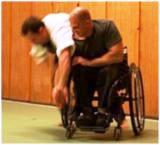 As a T-9 paraplegic, I have been interested in improving my chances of survival in a self-defense situation. It has been a journey that has led me to some very great and compassionate teachers. They have shared not only techniques with me, but sage wisdom. I'll do my best to relay what I have learned.
Do Not Be a Victim
There are many ways to look at self-defense, but in most cases an attacker or predator is looking to hang a victim tag on someone. One of our key focuses is not to be a victim. This is our strongest defense: "I WILL NOT BE A VICTIM!" This has ramifications into every aspect of our lives. Seeing ourselves as empowered and capable, we send this same message to those around us. The predators of the world also take notice. A lion or jungle cat does not go after the strongest of the herd. It goes after the slowest, smallest, or weakest. Human predators do the same. As people with disabilities, we overcome many challenges on a day-to-day basis. We want to focus this inherent will and courage to resist being victimized. Our will to surive in a self-defense situation can be our strongest ally.
What Are My Self-Defense Options?
You need to factor in your strength, agility, coordination, physical limitations, mindset, and mental and emotional states when figuring out a self-defense system or method that is right for you. All of these elements can be improved on with proper training and dedication. Since I'm able bodied from the waist up, I choose to focus on this strength when training and conditioning in the martial arts. I can still block, strike, grab, and twist. By utilizing wrist and other joint locks, I can actually flip someone from my chair. Do what you can do, and do it to the best of your ability. Even if you are very limited in any movement, the followng tactics can help keep you safe.
An ounce of prevention. Be aware of your surroundings. This may sound obvious, but every physical confrontation I experienced during my able-bodied days happened either in a bar, outside a bar, or while I was drinking. Be aware that if we feel compelled to be in these types of environments, the likelihood of an altercation is escalated.
Safety in numbers. If you have to be in an area of town that has crime problems or in unfamiliar territory late at night, you might ask one or more friends or co-workers to accompany you. The same is true if you leave work after hours. Unless someone is totally belligerent or has planned a mass attack, which will likely involve firearms, you are better off around other people than alone.
Did I say something? Do not underestimate the power of our voice. Even with moderate to extreme limitations in mobility, our voice is our first weapon of choice. Two methods of self-defense I have studied, FAST Defense and Model Mugging, both teach students to use their voice to put a would-be attacker on the defensive. We can think of any number of scenarios where we might encounter a conflict that could lead to possible bodily harm. Let's use our imagination and take an opportunity to confront a bad dream or our worst nightmare.
Passive and aggressive. Using your scenario, role play a victim in a pssive response. Do this with a partner or small group. Take turns playing the victim role. Be really passive, avoid eye contact, keep your head down, and act scared. Notice any feelings that come up, and honor them. Next reverse roles. Note how effective a passive response is in remedying the scenario you have created. Does it give more fuel to the perpetrator? Does he feel more empowered to continue his line of behavior?
Now play out an overly aggressive response to your situation. This could even involve vulgar language, cussing, and swearing. Remember we are having fun with this, so let it fly. Feel real anger and aggressiveness. How did this feel? How did it make the other person feel? Did it seem to do more to escalate any conflict that was already occurring?
The level of threat determines the level of assertiveness. We need to find a balance between passive and aggressive. If someone comes up and asks, "Do you know what time it is?" We don't want to say, "You dirty +#&%; get the #&%$ away from me." But if someone sets off our personal alarms and asks inappropriate questions, we need to respond assertively. First we should let the person know we are uncomfortable with his closeness, then ask him to back away. (Note: We have a right to our own personal space. If someone is within arm's length of us, he is within reach of possibly harming us.) If the person doesn't back off, we need to raise our tone of voice and forcefuly, say, "Back Away!" If he still doesn't listen, make a bigger scene and yell, "BACK AWAY!"
The second "Back Away" should be done with a 'Bad Dog' voice we would use to scold a pet. The third "BACK AWAY", if needed, should be done with a voice that will make everyone within shouting distance take notice. If we are still feeling threatened, we need to keep stating our boundaries and verbally backing the predator away. This continues even when we get to a level of physical conflict. The voice will allow us to use our full power. By yelling, we are actually breathing. When we stop breathing, we freeze; we can no longer respond assertively and at worst we become deer in the headlights.
Practice these scenarios. We have been raised in a society that taught us to be nice and polite. Raising our voices and yelling can make it seem like we are not being nice and are not playing by the rules. This may feel odd, but we need the full focus of attention to deal with what is in front of us, not on being "nice". Predators are also aware of the societal rules and are relying on us to play by them and be a victim. We may hear from them, "Be quiet and I won't hurt you." They are depending on our silence and cooperation with their game. Be aware of this. Out of the 60,000+ students in Model Mugging's 37-year history, around 800 who faced attacks after their training were able to dissuade their predators with verbal defense alone.
Assistive technology for safety. What if our disability prevents us from speaking or yelling? Building and car alarms are effective in preventing thefts; why can't we have our own personal alarms for safety? Air horns and sirens could be used on our chair or person. You may find these at boating or sporting goods stores. If you use a power chair or scooter, you can explore the possibiltiy of rigging up a high-powered horn or alarm to the battery system. If you make enough noise to wake the dead, chances are no one will want to be around you. Many cars and vans have alarms or panic butons. If you are near your vehicle when a situation arises, don't be afraid to use this alarm.
Help! It is red alert and going physical. I strongly recommend training in FAST Defense (www.fastdefense.com). FAST technology deals specifically with a fear-induced adrenal state, which you will experience in real life self-defense situation. The traditional martial arts are also valuable in providing physical conditioning, stamina, discipline, and other techniques. I have trained in Hapkido, Aikido, Jujutsu, and mixed martial arts, benefiting from them all. However, when in an adrenal fear state, many techniques that require fast motor skills are lost as the nervous system switches into a fight or flight response. FAST also employs armored assailants. We want to hit full force when fighting for our life, so we need to practice hitting full force. Trained armored assailants allow this with minimal chance of injury to themselves or the student.
Mibility as a weapon. I once saw someone inadvertently run over and dragged across the floor by a power chair during a dance. It was funny, but simultaneously scary. Once we have put a predator on the defensive with voice techniques, we need to incapacitate him in a physical attack. Both power and manual chairs have their footplates at about the level of an able-bodied person's ankles. If your safety is in jeopardy, roll over his foot and ankle with everything you've got. If you are able to strike, hit vital targets like the groin, eyes, throat, and nose. I recommend palm heel strikes, as they are less likely than a closed fist to break your wrist or knuckles. If a situation becomes physical, something has already gone wrong. Don't question why. Do what you need to do and fight. If someone is trying to take you to a second location, the time to fight is now. It will just get worse if you are taken somewhere else.
Man's best friend. The ADA affords assistance animals as a reasonable accommodation. An aggressive attack/assistance dog is a good ally should we get involved in a physical conflict. In many instances just the presence of a large canine (i.e., German shepherd or other breeds) is a good deterrent against a predator. Training of this nature for the animal takes time, patience, and dedication. Aggressiveness in dogs needs to be balanced with a calm demeanor when conflict is not occurring, otherwise you will have a liability on your hands. Trained properly, a dog can be a very good self-defense option, especially for those of us with severe mobility impairment.
Stay focused, confident, and open to other safety ideas. You may want to contct a crime prevention officer in your local police department to see what programs they offer. They can let you know about other self-defense options, such as pepper spray. Remember, it takes a warrior spirit to live with a disabiltiy. We can use this same warrior spirit to fight for our lives. Live and love life. Don't be a victim.